A love letter to the library
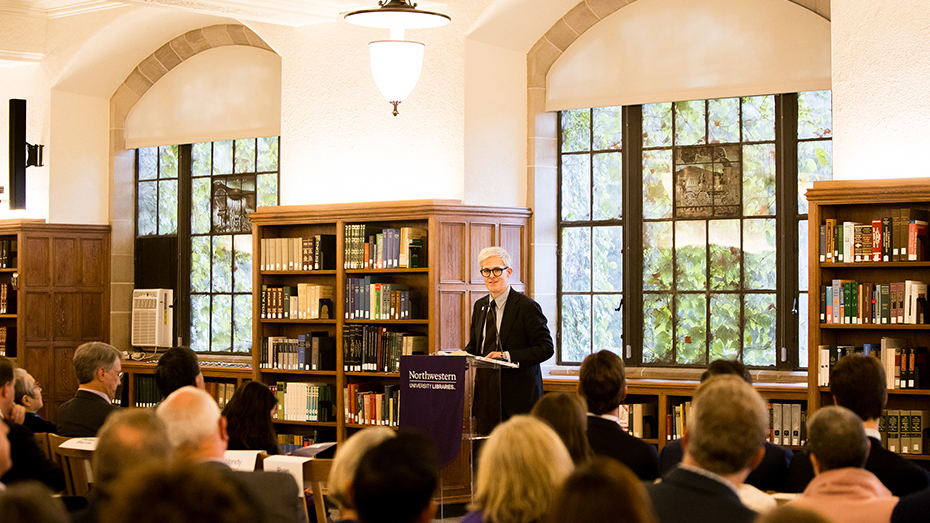
No other space on campus has as much meaning for me.”
Good evening, President Bienen, Dean Wang, esteemed guests, and dear friends and colleagues. It is an honor to offer some remarks on this wonderful occasion— the rededication and renewal of Deering Library. No other space on campus has as much meaning for me. Deering has been the center of my teaching since I arrived here 12 years ago and has been essential for my research for nearly 20. Deering has been a catalyst for intellectual transformations—my own as well as my students’. I celebrate this power today, honoring Northwestern’s commitment as well to the scholarly and pedagogical virtues for which it stands.
My relationship with Deering began in the fall of 2006 while completing my PhD work at Columbia University. I had fled Morningside Heights for Chicago, mostly for love but also with the hope that the change of scenery might help me figure out how to be a real scholar. Happy accident then that one of the major archives for my research on composer Morton Feldman was the John Cage Collection held here.
And so, one fall day I made the long CTA trip from Logan Square. In those days one couldn’t enter Deering directly, so I wended my way through Main Library, into the subterranean passage, and up the marble stairs to the Music Library. Greeted by then–music librarian Jeanette Casey, I was handed folders of correspondence between John Cage and his collaborators as well as performance ephemera that I hadn’t imagined could still exist. It was at that moment I set out on the path I’ve been on since: investigating through archival work the intimate ties produced and sustained through experimental music making.
At the time, I didn’t dare imagine that I might one day actually work here. There was no precognitive flash accompanying my scholarly insights aided and abetted by Morton Feldman’s letters to John Cage. But six years later, I found myself in D.J. Hoek’s office during a campus interview for a position as assistant professor of musicology in the Bienen School of Music. To say that D.J. and I hit it off would be an understatement. As the chanteuse Nico said of Jim Morrison, he is my soul brother. Already we began making plans for the kinds of classes I could teach using the archives. D.J. showed me a recent acquisition, a notebook of John Cage’s that proved immediately relevant to an essay I was writing at the time. I dared not get my hopes up even as I realized that this would be, without a doubt, the perfect job. Happily, Dean Toni- Marie Montgomery also thought it would be a perfect job for me. And since 2013 I’ve made Deering a laboratory for experiments in teaching supported by active research with its distinctive collection.
Since 2013 I’ve made Deering a laboratory for experiments in teaching supported by active research with its distinctive collection.”
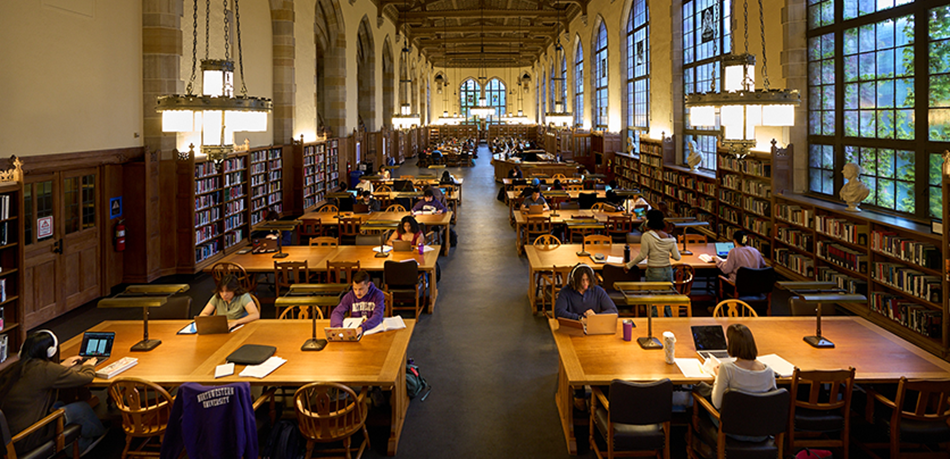
I can’t overstate how Deering and its librarians have transformed not only my work, but scores of my students. From undergraduates to graduate students, young people come alive when brought face-to-face with a seemingly insignificant bit of ephemera that turns out to be evidence on which they can build unprecedented insights. I think, for instance, of my former PhD advisee Olivia Cacchione. She began as a student in my music historiography seminar, which met in the Beck Room. Olivia was drawn to the Death Collection, as it is colloquially known, locating within it evidence of the undersung history of spiritualism, séances, and musical mediumship. What began as a class project became her dissertation research. This work, begun here, took her to archives across the US and the UK, bringing her fellowships from the Mellon Foundation and Social Science Research Council, and gave her the experience that won her an archivist job in Philadelphia. Olivia’s path is a striking example of how learning in Deering changes lives by melding teaching, research, and professional development—and I look forward to further work with you all to see how we might develop these dimensions of our students’ education further.
The successes that Deering affords—the epiphanies and intimate encounters it stages with the past—would not be possible without the people who work in it. And what people. Anything I’ve achieved as a teacher and a researcher is because Scott pointed me to something in the Charlotte Moorman collection that I didn’t know about, because Jason scanned a document for me in a pinch during the depths of the COVID lockdown, because Catie helped students navigate a finding aid, because Nick and Benn always made sure the materials I needed for a class were ready to go, because Tonia and Katie took extra time to prepare items for a seminar exhibition, because Mary Rose got the classroom door unlocked, and because Greg and D.J. supported whatever crazy scheme I had cooked up that year (like this winter’s Yoko Ono symposium). It’s my wish that Deering’s renewal has made it an even better home for them, and I offer thanks for all they have done to make it home for me. Here’s to our continued work together in the glorious library.