Students get a charge out of new lending machine
Automated delivery of cables and other devices helps users at all hours
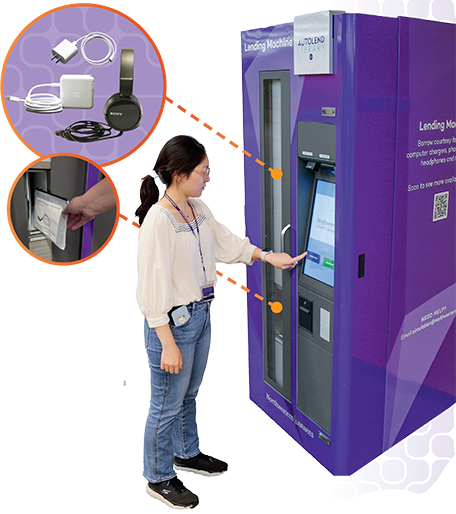 This fall students can find a lending machine in University Library, across from the circulation desk, where they can check out small, useful items like phone chargers, USB adapters, scientific calculators, and headphones. Running low on battery now doesn’t have to mean powering down their studies.
The lending machine is the brainchild of Danielle Cotrone, interim head of access services and coordinator of public service desks.
“We knew there were students who needed these items after the circulation desk had closed for the day,” she said. “Not only that, the sheer number of requests during service hours meant that an automated solution could simplify things for students and for us.”
Still, Cotrone couldn’t predict how quickly library visitors would take to the machine. That’s why the access services team planned a soft rollout of the device at the end of spring quarter. The machine debuted with no fanfare, other than a few instances when staff stood beside it to answer questions from curious passersby. At the end of the two-week test, the machine had loaned a whopping 500 items. Confirmed: Students were more than ready.
“The library is open 24 hours a day during those end-of-quarter weeks, but the circulation desk has never been staffed all those hours,” Cotrone said. “We were hoping to expand the ability to check out these items that are so desperately needed. It turns out that people really wanted it and were grateful for it.”
The device is modeled on machines that many rural libraries use to lend and receive returned books (similar to the once-ubiquitous DVD rental boxes outside retail stores). But when Cotrone shopped her idea around to vendors, none had ever devised one to be used in the way Northwestern planned.
For instance, the machine needed to deliver items and receive them once returned, use patron data to track transactions, and dispense items of different sizes and weights—a particular challenge for a machine built to distribute books.
“These items are not as heavy as books, and they’re not a standard size,” Cotrone said. Awkward, ungainly items like charging cords needed to be contained in bags, but that only solved part of the problem, because the bags can get caught inside the machine. Over the summer, Cotrone and her team tweaked both the delivery system and the instructional signage. (A sign now prompts users to push their bags all the way into the return slot, which has solved many of the jammed-bag issues.)
The team has also perfected signage to assist users with their selections. Photos help users determine whether they need USB-A or USB-C cords—or perhaps they really need a lightning connector? Clear instructions and a simple operation help users get what they need quickly: Tap their Wildcard, touch an image on the screen, and wait for the dispenser door to open.
“The data shows we have a lot of repeat users,” Cotrone said. “That means people rely on it. That's all we care about—that people are happy with the service we’re providing.”